

Every month, hundreds of thousands of pounds flow through online gambling websites that have no legal right to accept bets from people in Great Britain. As of 6 November 2026, the UK Gambling Commission’s newest evidence confirms the illegal online casino market has not gone away — it has simply become harder to spot. This article explains, in plain terms, what the latest data shows, how unlicensed sites operate, and exactly how a player in the UK can check whether an online casino is actually legal before depositing a single penny.
Direct answer: Is it illegal to use an unlicensed online casino in the UK?
Yes. Any online casino accepting bets from consumers in Great Britain must hold a licence from the Gambling Commission, and sites without one are operating illegally regardless of where they are based. According to the Gambling Commission’s illegal gambling dashboard published on 5 November 2026, 586 illegal gambling websites were accessible to UK consumers in September 2026, and an estimated 0.6% of survey respondents had used one in the previous four weeks. Using one is not a criminal offence for the player, but it strips away every consumer protection — including dispute resolution, identity checks, and guaranteed payouts — that a licensed site is legally required to provide.
What the Gambling Commission’s November 2026 data actually shows
The Gambling Commission publishes a rolling illegal-gambling dashboard as part of its effort to measure and disrupt the unlicensed market. The edition released on 5 November 2026 covers September 2026 and offers one of the clearest pictures yet of how large — and how active — this market remains.
The headline figure is that 586 illegal gambling websites were identified as accessible to consumers in Great Britain during September 2026. That is 4% below the preceding three-month average, but 4% above the equivalent figure from September 2025 — meaning the market is roughly flat on an annual basis despite short-term fluctuation. Alongside those websites, the Commission identified 97 affiliate webpages containing links to illegal gambling sites, a 26% decrease from the previous three-month average, suggesting that affiliate-level disruption work may be having some effect even as the core website count holds steady.
| Metric (September 2026) | Figure | Change vs. prior 3-month average |
|---|---|---|
| Illegal gambling websites accessible in GB | 586 | −4% |
| Affiliate webpages linking to illegal sites | 97 | −26% |
| Gambling-related Google searches leading to illegal sites | ~4% | — |
| Estimated engagement with illegal sites | +12% vs. prior average; −11% vs. Sept 2025 | Mixed |
| Illegal websites disrupted (Q2, FY2026–27) | 311 | +38% vs. previous quarter |
How we know: all figures in this table are drawn directly from the Gambling Commission’s illegal gambling dashboard, published 5 November 2026, covering data for September 2026 and the second quarter of the 2026–27 financial year.
Search behaviour data is particularly telling. Around 4% of gambling-related Google search results in September 2026 led users to illegal gambling websites. Meanwhile, searches for terms closely associated with the illegal market — including the well-known phrase “not on Gamstop” — were down 53% compared with the preceding three-month average and 22% lower than in September 2025. That decline in explicit searching for unlicensed sites is encouraging, yet estimated engagement with the illegal websites that remain accessible actually rose 12% against the recent average, even though it was 11% lower than a year earlier. In other words, fewer people appear to be actively hunting for unregulated sites by name, but those who find illegal operators — often through less direct routes such as search engine ads, forums, or affiliate links — are engaging with them more than in recent months.
How many people actually use illegal online casinos?
The Gambling Commission’s figures distinguish between the general population and people who actually gamble online, and the gap between those two groups is stark.
- At population level, an estimated 0.6% of respondents had used an illegal gambling website in the previous four weeks.
- A further 0.4% had used one during the previous 12 months, but not within the most recent four weeks.
- Among people who had gambled online in the previous four weeks specifically, an estimated 2.5% had engaged with illegal gambling websites.
- Among people who had gambled online in the previous 12 months, a further 1.5% had engaged with illegal sites during the year but not in the most recent four weeks.
- The Commission reported that 94.4% of respondents showed no indication of using an illegal gambling website at all.
Read together, these numbers tell a reassuring but not complacent story: the large majority of people in Great Britain never touch the illegal market, but among active online gamblers, roughly one in forty has engaged with an unlicensed site in the past month alone. That is a meaningful minority, and it is precisely the group this article is written for.
Where the baseline numbers come from
These engagement figures sit alongside the Gambling Survey for Great Britain, which used a nationally representative sample of 5,277 adults aged 18 or over, surveyed between 19 January and 26 May 2026. That survey found online gambling participation in the previous four weeks stood at 39%, falling to 16% once people whose only online gambling activity was lottery draws were excluded. The most common online gambling activities recorded were National Lottery draw tickets (25%), other charity lottery tickets (15%), and online instant-win games (8%). This context matters because it shows the illegal-site engagement figures are measured against a genuinely large, active online gambling population — not a small or unrepresentative sample.
What enforcement action is actually happening
The Gambling Commission does not only measure the illegal market — it actively disrupts it, and the latest disruption figures suggest that effort has intensified. In the second quarter of the 2026–27 financial year, disruption action was taken against 311 illegal gambling websites, a 38% increase on the previous quarter. Crucially, this activity appears to be working: following disruption action, 77% of affected websites saw a reduction in estimated traffic, 26 percentage points higher than in the previous quarter.
Disruption typically involves working with search engines, payment processors, domain registrars, and advertising networks to make illegal sites harder to find, harder to pay into, and harder to promote — rather than a single dramatic takedown. The rising success rate suggests this layered approach is becoming more effective, even as the overall number of accessible illegal sites has stayed broadly stable year-on-year.
Why illegal online casinos are hard to shut down completely
Illegal online casinos are rarely run by a single company with a fixed address. Many operate from jurisdictions with weak or no gambling regulation, using domain names that can be swapped or mirrored within hours of being blocked. Some rebrand repeatedly under new names once a previous site is disrupted, while others rely on affiliate marketers — exactly the kind of “affiliate webpages” the Gambling Commission tracks — to drive traffic without the core operator ever appearing in search results directly.
This is also why search-term trends matter so much to regulators. A 53% drop in searches for explicit phrases like “not on Gamstop” suggests public messaging about the risks of unlicensed gambling may be landing, even if a hard core of users continues to seek these sites out through other channels, such as direct links shared in online communities or messaging apps.
How to check whether an online casino is actually licensed
Because illegal sites increasingly imitate the look and feel of legitimate operators, the only reliable way to confirm legality is to check directly, rather than relying on appearance, reviews, or claims made on the site itself.
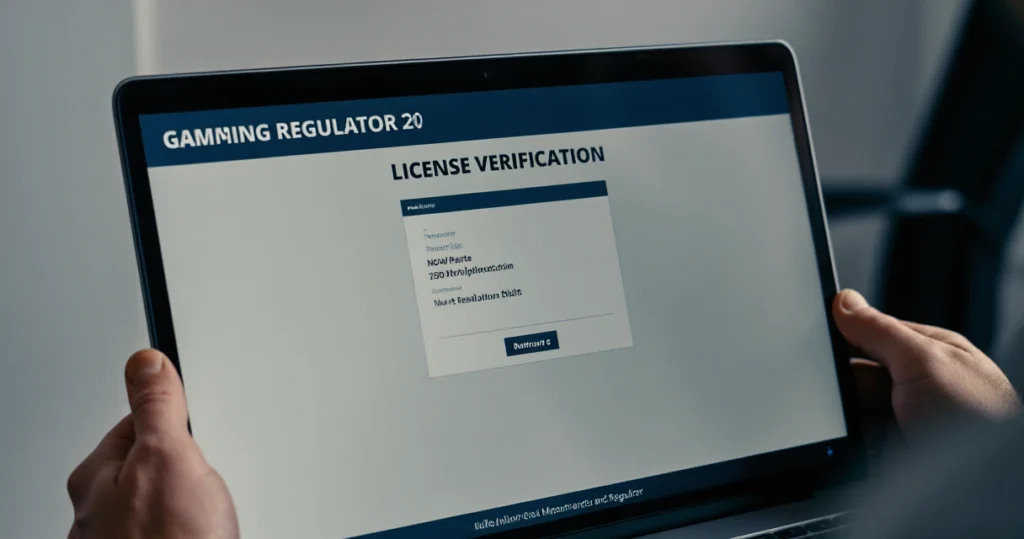
- Look for a Gambling Commission account number, usually displayed in the site footer, and cross-check it against the Commission’s public register of licensed businesses on gamblingcommission.gov.uk.
- Be cautious of any UK-facing casino that markets itself as “not on Gamstop” — this phrasing is strongly associated with the illegal market, and the Gambling Commission has specifically tracked search volume for this exact term.
- Check whether the site accepts standard UK payment methods through regulated banks and e-wallets; illegal operators often rely on cryptocurrency-only payments or unusual third-party payment intermediaries to avoid scrutiny.
- Search for the operator’s name alongside “Gambling Commission” to see whether it has appeared on any enforcement, warning, or disruption notices.
- Be wary of sites that appeared very recently, use a domain only loosely related to their brand name, or that you discovered through an affiliate link rather than a direct search.
Licensed vs. illegal online casinos: what actually changes for the player
The practical difference between a licensed and an illegal online casino is not cosmetic — it changes what protection a player actually has if something goes wrong.
| Protection | Licensed UK casino | Illegal/unlicensed site |
|---|---|---|
| Gambling Commission oversight | Required | None |
| Identity and age verification | Legally mandated | Often absent or superficial |
| Access to independent dispute resolution | Available | Not available |
| Self-exclusion scheme recognition (e.g. Gamstop) | Enforced | Typically bypassed or not recognised |
| Guaranteed fund segregation | Required under licence conditions | No legal requirement |
| Routine disruption/monitoring by regulator | N/A — already compliant | Actively targeted (311 sites disrupted in Q2 FY2026–27) |
How we know: licensing and protection requirements reflect the Gambling Commission’s published licence conditions; disruption activity figures are taken from the Commission’s illegal gambling dashboard, 5 November 2026.
One of the clearest practical risks is around self-exclusion. Players who have signed up to Gamstop do so specifically to block themselves from licensed gambling sites during a vulnerable period. Illegal operators marketing themselves as “not on Gamstop” exist specifically to circumvent that protection — which is precisely why the Gambling Commission tracks search interest in that phrase as a leading indicator of illegal market activity.
The scale of the legal online gambling market, for context
It is worth placing the illegal market in context against the legal one. Gambling Commission business data covering approximately 70% of the online market recorded 260,827,022 bets in the “other gaming, including casino” category during the relevant quarter shown in its March 2026 business-data release, alongside 71,180,853 total online gambling sessions for the corresponding period. Set against figures of that scale, the illegal market’s 586 identified websites and single-digit percentage engagement rates represent a genuine but comparatively small slice of overall UK online gambling activity — concentrated among a specific subset of online gamblers rather than spread evenly across the whole player base.
Why payout speed and site legitimacy are connected
Players researching withdrawal times often discover licensing status along the way, because the two issues are closely linked. Licensed casinos operate under rules that govern how quickly and fairly withdrawals must be processed, and they are accountable to the Gambling Commission if they fail to do so. Illegal sites have no such obligation, and slow, inconsistent, or simply non-existent withdrawals are a common red flag reported by players who later discover they were using an unlicensed operator. For a detailed breakdown of what genuinely affects payout speed at properly licensed UK casinos, see our companion guide, Online Casino Withdrawal Times in 2026: What Really Determines Payout Speed.
What to do if you think you’ve used an illegal site
If you suspect you have deposited money with, or still hold a balance on, an unlicensed online casino, there are concrete steps worth taking rather than simply walking away.
- Stop depositing further funds immediately and attempt to withdraw any remaining balance.
- Contact your bank or payment provider, since illegal gambling transactions can sometimes be challenged or reversed, particularly if made by card.
- Report the site to the Gambling Commission, which uses player reports as part of the evidence base behind its disruption programme.
- If you are concerned about your gambling behaviour more broadly, contact GamCare or the National Gambling Helpline for free, confidential support.
- Register with Gamstop if you have not already done so, and remember that this only blocks licensed sites — it will not automatically stop illegal operators from accepting your custom, which is itself a reason to avoid them entirely.
Future outlook: what the trend suggests for 2027
The most recent quarter-on-quarter data points in a cautiously positive direction. Disruption actions rose 38% quarter-on-quarter, and the proportion of disrupted sites that subsequently lost traffic jumped 26 percentage points to 77%. At the same time, searches for explicit illegal-market terms fell sharply. Taken together, this suggests enforcement efforts are becoming measurably more effective at the margins, even though the raw count of accessible illegal websites has not fallen dramatically over the past year.
The more difficult trend is the 12% rise in estimated engagement with illegal sites compared with the recent average. This hints that the remaining illegal operators — those not yet disrupted, or quick to resurface after disruption — may be capturing a more committed audience even as casual searching for them declines. For players, the practical lesson does not change from one quarter to the next: verification before deposit remains the single most effective protection against the illegal market, regardless of how the headline numbers move.
Limitations of this data
This article relies on the Gambling Commission’s own published dashboard and survey figures, which are themselves estimates based on monitoring and sampling rather than a complete census of every illegal site or every player’s behaviour. Figures such as website counts and search-term volumes can be affected by how illegal operators structure their domains and marketing, which may shift faster than any single quarterly report can capture. The engagement percentages are drawn from survey self-reporting, which can under- or over-state true behaviour. Readers should treat the figures as a robust, regulator-verified snapshot of September 2026 and the second quarter of the 2026–27 financial year, not a real-time or complete picture of the illegal market at every moment.
Conclusion
The Gambling Commission’s newest evidence, published 5 November 2026, shows an illegal online casino market that is neither vanishing nor growing dramatically — it is being actively contested. Disruption efforts are intensifying and showing real results, public searching for explicit illegal-market terms is falling sharply, yet a committed minority of online gamblers, around one in forty in the most recent four-week period, continue to engage with unlicensed sites. For UK players, the single most useful habit is also the simplest: before depositing anywhere, check the Gambling Commission’s public register, be sceptical of any “not on Gamstop” marketing, and treat payout reliability and licensing status as two sides of the same question.
Related Reading
Sources: Gambling Commission illegal gambling dashboard (published 5 November 2026); Gambling Survey for Great Britain (fieldwork 19 January–26 May 2026); Gambling Commission business data release (March 2026). For official guidance and to check an operator’s licence status, visit gamblingcommission.gov.uk. For free, confidential support, contact GamCare or the National Gambling Helpline. To self-exclude from all licensed UK gambling sites, visit Gamstop.

Daniel Reeves
Payments & Bonuses Editor · fintech backgroundDaniel Reeves is CasinoBonusesGuide's Payments & Bonuses Editor. With a background in fintech and payment operations, he breaks down the parts of online gambling that cost players the most: wagering requirements, maximum-bet rules, payout speeds and hidden fees. Daniel maps every bonus offer against its real, achievable value rather than its headline number, and verifies each casino's deposit and withdrawal options against the operator's own cashier and the payment providers' official terms, so our payment guides reflect what the sites actually support. He believes a fair 20x bonus beats a flashy 50x one every time.